NASA and ESA describe the space telescope’s image as a “tapestry of blazing starbirth.”

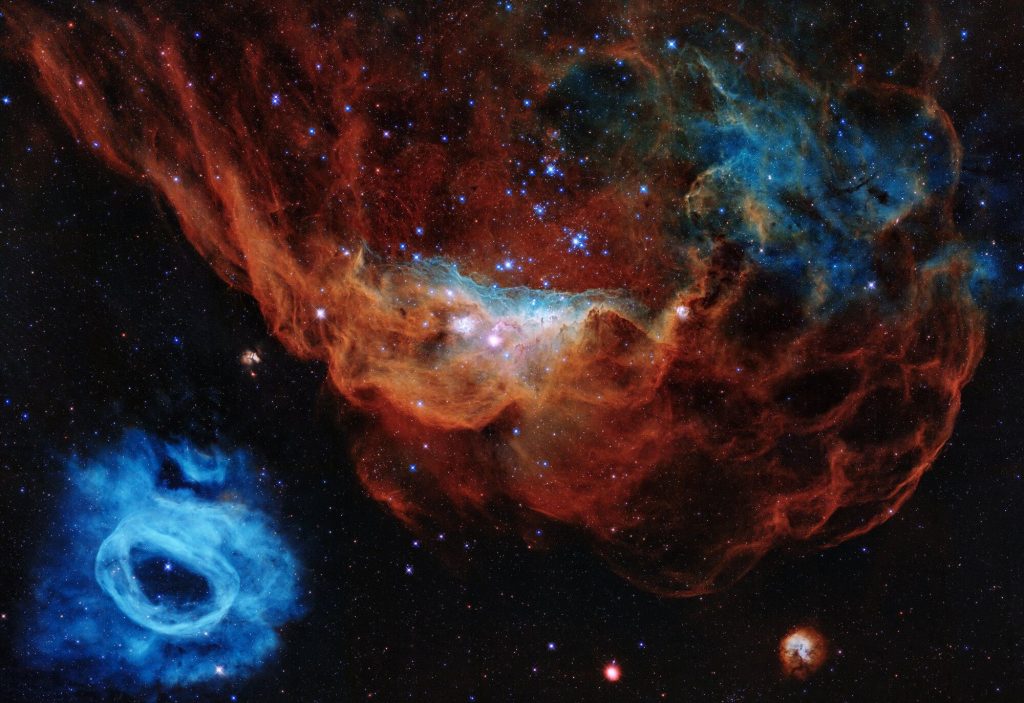
NASA and ESA marked the Hubble Space Telescope’s 30th anniversary in 2020 with the “Cosmic Reef” image of two nebulae. NASA, ESA and STScI
The Hubble Space Telescope looks out into the cosmos and brings the beauty and mystery of the universe back to Earth. After 30 years, it’s still a source of wonder.
NASA and the European Space Agency (ESA) are celebrating the 30th anniversary of the telescope’s launch into space on April 24, 1990. The birthday cake is what the agencies call a “tapestry of blazing starbirth.”
This one is of a star-forming region close to our Milky Way Galaxy, about 163,000 light-years from Earth.
The larger object is the nebula NGC 2014; its companion is called NGC 2020.
Hubble scientists nicknamed the image “Cosmic Reef,” because the sparkling, brilliant structures resemble a cosmic coral reef glistening in some secret corner of a deep ocean. This image was taken by Hubble’s Wide Field Camera.ESA pointed out a group of bright stars near the center of the red nebula “that has blown away its cocoon of hydrogen gas (colored red) and dust in which it was born.” NGC 2014’s shape gives it its nickname of the Brain Coral nebula.
They live in the Large Magellanic Cloud, an orbiting satellite galaxy of our own Milky Way. At 163,000 light-years away, we won’t be visiting anytime soon, but Hubble was able to capture a lovely view of the ethereal, cloudlike areas of active star formation.

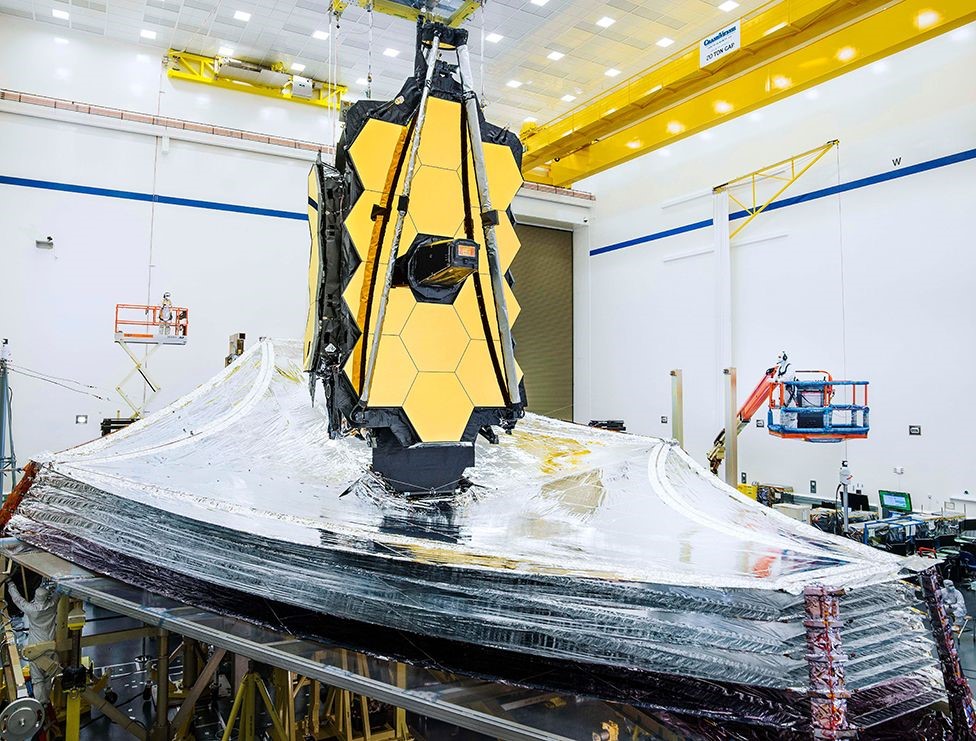
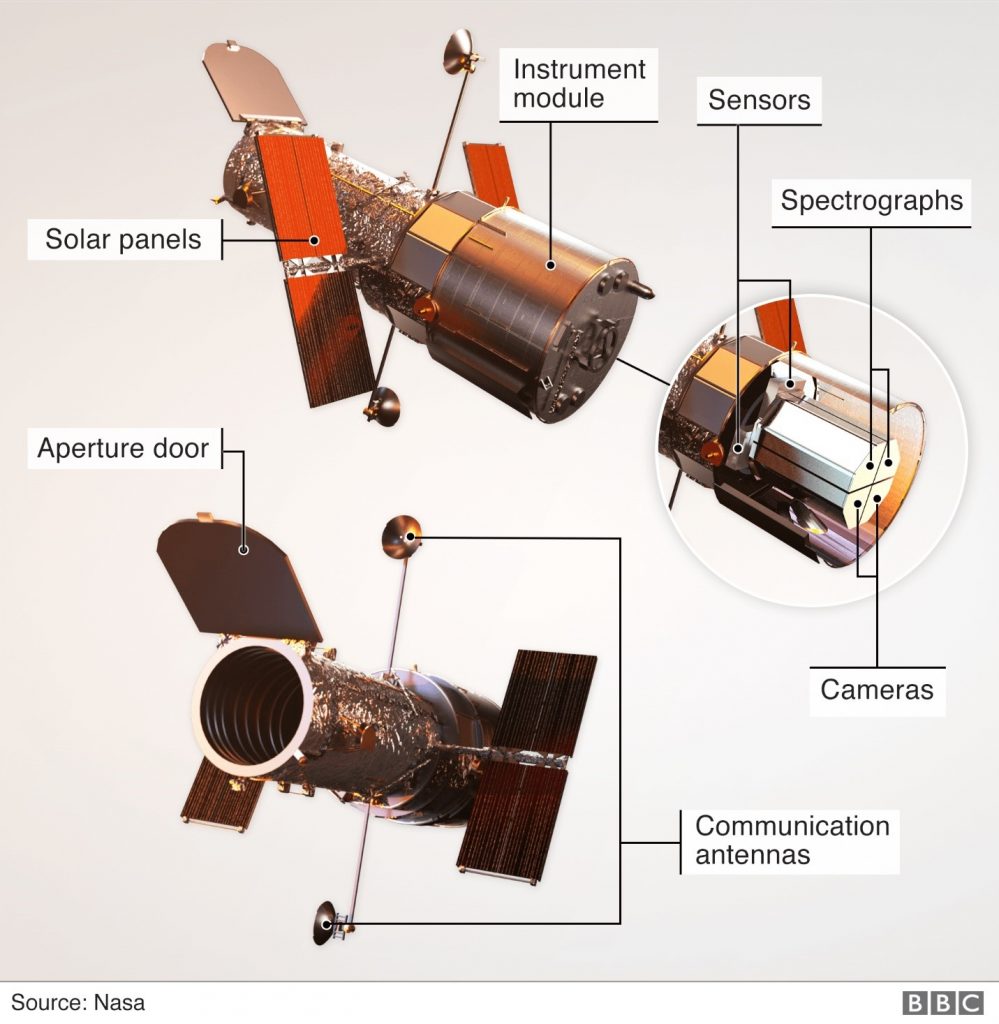
Hubble has been a resilient machine, but it’s needed some human help along the way. Five space shuttle servicing missions kept it in operation. NASA expects it to continue its science mission through the 2020s. It’ll eventually be joined in space by its not-yet-launched successor, the James Webb Space Telescope.
JWST will study the Universe at longer wavelengths of light
“It was revolutionary to launch such a large telescope 30 years ago, and this astronomy powerhouse is still delivering revolutionary science today,” said NASA’s Thomas Zurbuchen. “Its spectacular images have captured the imagination for decades, and will continue to inspire humanity for years to come.”

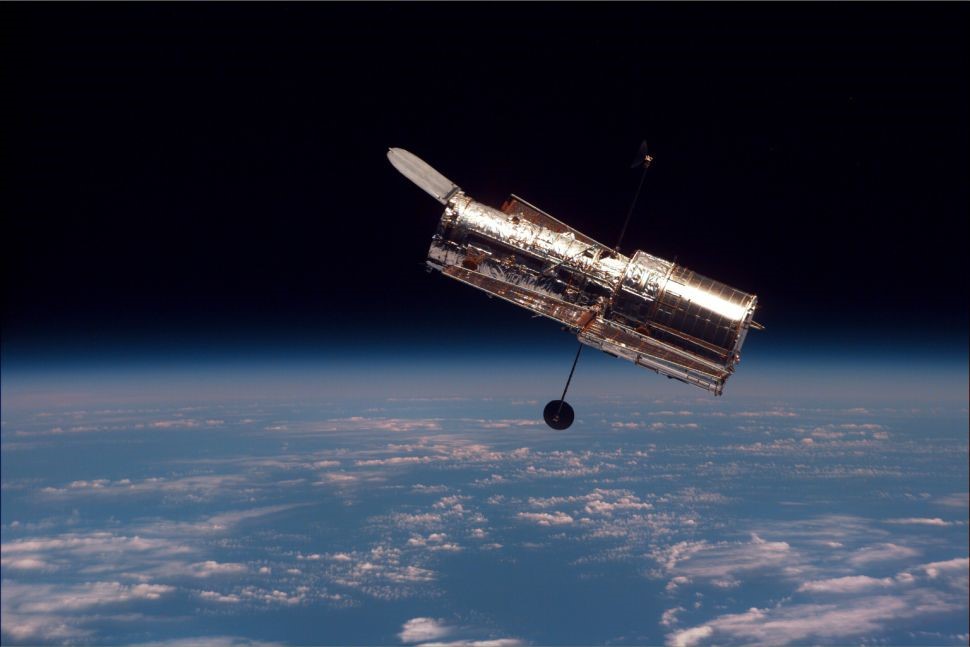
The Hubble Space Telescope as seen from the space shuttle Discovery during the second servicing mission in 1997. (Image credit: NASA/STScI)
Since it launched in 1990, the space telescope has made over 1.4 million observations of over 47,000 celestial objects, producing over 164 terabytes of data and leading to over 17,000 scientific papers and counting.
Observations made with Hubble confirmed the existence of supermassive black holes in the centers of galaxies and even led to the discovery of dark energy. Using Hubble observations, scientists were also able to create the best 3D maps of dark matter, showing how the mysterious matter is distributed throughout the universe.

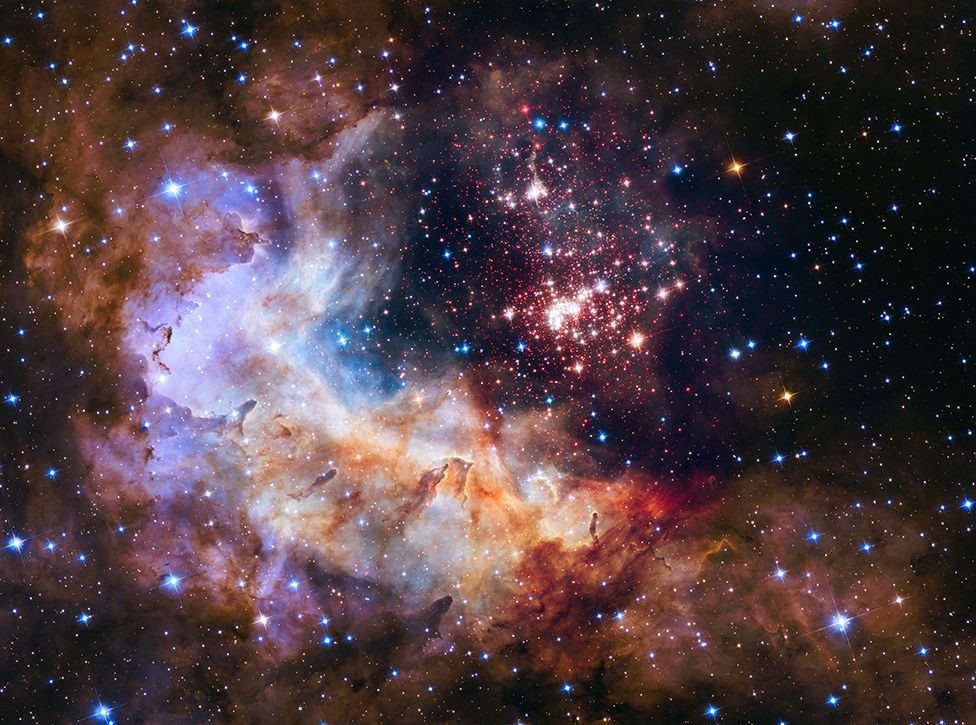
For its 25th birthday, Hubble imaged a giant cluster of stars called Westerlund 2

What has Hubble contributed to science?
It’s a bit of a cliche, but Hubble has truly been a “discovery machine”.
Before the telescope launched in 1990, astronomers didn’t know whether the Universe was 10 billion years old or 20 billion years old.
Hubble’s survey of pulsating stars narrowed the uncertainty, and we now know the age extremely well, at 13.8 billion.
The observatory played a central role in revealing the accelerating expansion of the cosmos – a Nobel Prize-winning breakthrough – and it provided the definitive evidence for the existence of super-massive black holes at the centre of galaxies.

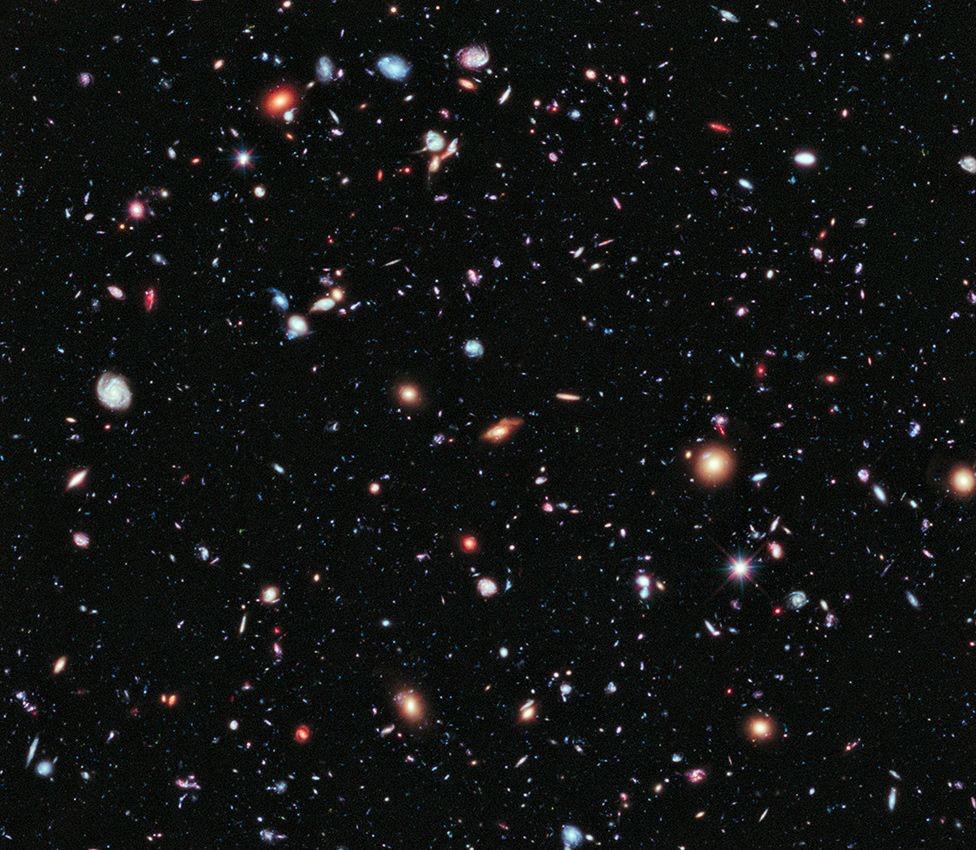
The Deep Field images require Hubble to stare at the same patch of sky for days on end
It’s amazing to think that when Hubble was launched, scientists had yet to detect the first exoplanet, the name given to a planet orbiting a star other than our Sun. Today, Hubble is pioneering the study of these far-off worlds, examining their atmospheres to try to gauge their nature.
And although the sparkling eight-metre-class ground-based telescopes can now match – and even exceed – Hubble’s skill in certain fields of study, the space telescope remains peerless in going super-deep.
Its so-called Deep Field observations in which it stared at a small patch of sky for days on end to identify the existence of very distant, extremely faint galaxies is one of the towering achievements in astronomy.
These studies have shown us what the Universe was like just a few hundred million years after the Big Bang. Only JWST, with its finely-tuned infrared detectors, will go deeper still.

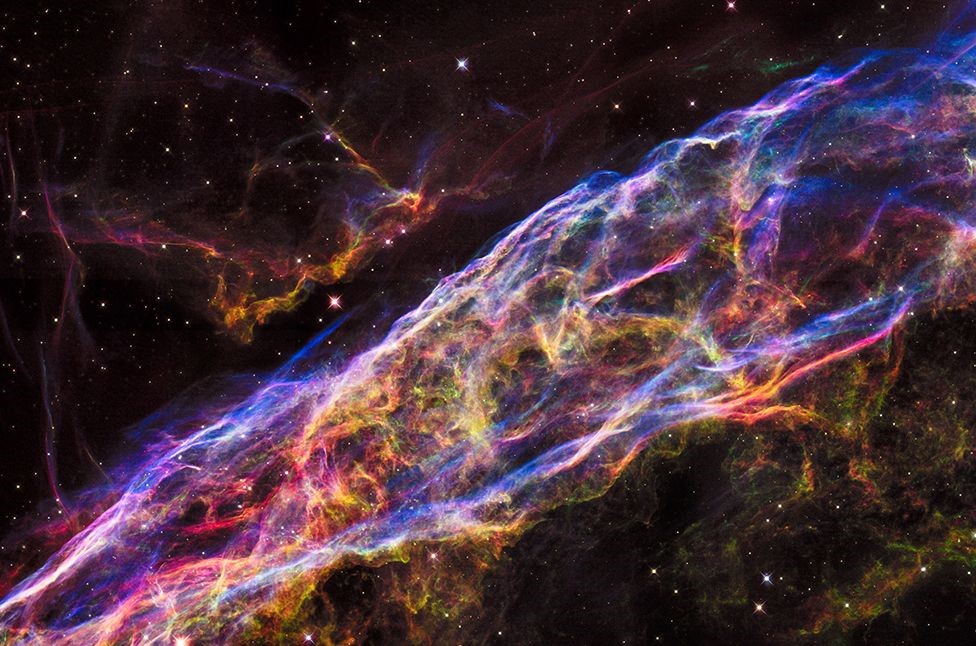
A Hubble classic: The Veil Nebula is the expanding debris of an exploded star
Hubble has discovered some of Pluto’s moons and provided new information about protoplanetary disks (the disks of gas and dust that surround a star and form planets and celestial objects) and gamma-ray bursts, the strongest and brightest explosions in the universe. The space telescope has even captured the moment when the comet Shoemaker-Levy 9 collided with Jupiter in 1994.
Hubble’s observations have led to an incredible wealth of discovery and exploration. But, even more so than just scientific discovery, the images collected by Hubble opened humanity’s eyes to what really lies out in the universe. For the first time, people could see in stunning detail what nebulas look like “up close,” or how the planet’s in our solar system are patterned with incredible clouds and structures.
“I think, maybe in my opinion, the coolest thing,” former NASA astronaut Mike Massimino, who flew on the last two servicing missions to the telescope, recently told Space.com about Hubble, is “it takes us to places we could only dream about going and shows us the beauty of the universe that’s out there.”
Hubble’s future
Hubble is still going strong 30 years after it launched. “Hubble is doing great because after we refurbished it 10 years ago, now we have two new cameras and these cameras were built so that everything on them is redundant if something breaks, it means that we can switch on the other side and continue to operate,” Sabbi said. “We think that we will probably have another 5 to 10 years and it will give us great discoveries.”
They added that soon, the James Webb Space Telescope will soon launch and add to this incredible observing power. “It’s a different telescope it will look at different parts of the electromagnetic spectrum so it will give us a different perspective of the properties of stars and galaxies and it will see the early universe. And combining what Hubble can see with this telescope — it will be amazing, we will have a brand-new perspective of the universe,”
Publication Courtesy – NASA , www.bbc.com . www.space.com